Friday, October 23, 2009

Trekking

Warning: This is a long blog covering my three-day trek in the Annapurna region. There are 94 photos in the album linked below, so beware!
Trekking

Day 1: Pokhara to Landruk
Backpack stuffed to the gills, hiking boots on, I meet my guide, Bhagwati and get into a tiny car to head to the mountains to start my three-day trek. Along the way, the entire Annapurna range is visible in the crystal clear morning sun – snow-capped peaks rising above green rice paddies. It is glorious and I get excited about seeing them up closer.

After an hour’s drive, we arrive in Kande, a pit stop on the road where we will pick up the trail to the village of Landruk, where we will spend the first night – about a five-hour hike. The trail starts at about 1200 meters above sea level. We walk through fields and beside homes and farms, then begin to ascend into more forested terrain. Part of the trail leads through jungle, past many small waterfalls. Much of the trail is lined with stone, creating one long stone stairway. I am surprised at the sheer number of steps. The stone is some sort of slate material, apparently native to the area. But someone must have cut it and moved it and leveled the ground for each step – an amazing feat considering how many miles of trail are so laid out. At one spot, we see a sign attributing a section of the trail to the nearby village. I suppose the villagers benefit from the trails, both for transporting themselves and their goods and for bringing tourists.

Along our path, there are several small villages boasting quaint restaurants and guest houses for weary trekkers. All have flower gardens, sunny patios, and colorfully painted rooms. My guide knows people at many of these spots and exchanges friendly conversation with other guides we pass on the trail. Despite seeing a number of other trekkers, guides and porters, we are often alone on the trail with just the sounds of the jungle and the occasional bells of a goat herd or donkey train. The porters carry baggage for trekkers, as well as all of the food, drinks and supplies for the mountain inns, tied in a bundle or basket and attached by a strap around their foreheads. They walk at an amazing pace – up and down – despite their heavy loads. Once or twice we pass a train of donkeys carrying supplies (especially gas canisters), but the human porters do much of this hard labor.

After hiking for two and a half hours, mainly uphill, we stop at a village called Pothana for lunch. It is windy and cold on my sweaty, tired body. We order hot tea and momos – delicious! Renewed, we set out again. The next hour is almost entirely downhill – again on the beautiful stone staircase that seems to never end. By the time we reach the bottom, my legs are shaky. Only a little more to go, says Bhagwati, mostly flat. She’s right. There are short ups and downs, but my shaky legs get me safely to Landruk. Across the valley – on the opposite hillside, my guide points out the village of Ghandruk, where we will sleep the second night. It is higher in elevation than Landruk, but to get there we must descend to the valley floor and then up again to nearly 2000 meters (Landruk is 1500 meters). I have thoughts of going home – is helicopter evacuation possible?

We check into the Tibet Guest House – cozy but primitive. At least it has a nice hot shower (feels nice on my tired back and legs)! The food and tea are warm and tasty. The daal bhaat comes with a delicious chutney made of home-grown mint, chilis, and tomatoes – and the daal is made with two types of tiny lentils. There is a large French Canadian group staying at the lodge, and they have ordered apple pie; it smells divine.

Our room (Bhagwati shares my room because the inn is full – normally the Nepali guides and porters have separate quarters) is equipped with two twin beds, which appear clean, and very thick, warm-looking duvets. The evening is cloudy, so I don’t know where the mountains are or what kind of view to expect. I pray it doesn’t rain and the clouds clear by morning. When I get up at 3 AM to visit the facilities, the sky is full of stars, so I know my prayers have been answered.

Day 2: Landruk to Ghandruk
Sure enough, when I go out to brush my teeth in the morning I find myself facing these magnificent peaks dominating the landscape – they look so close! Amazing to think that something so huge could have been completely invisible in the clouds the day before.

Breakfast is chiyaa and a banana pancake. Fortified, we pack up and head down, down, down, to the bottom of the valley before ascending up the other side. Our trail consists of about a million stone steps, past fields of rice, millet and mustard. All I can think of is the up, up, up awaiting me on the other side, but I decide not to let it worry me. The descent takes 45 minutes, and my legs are not too shaky.

At the bottom of the valley, we cross a bridge over a raging green-blue river fed by numerous waterfalls on both sides that we see from the trail. Stalling for time before the steep uphill climb, we stop for another cup of tea at a guest house in the village of Kumi. Then off we go up a billion stone steps. We go very slowly, resting frequently to enjoy the scenery. The mountains are visible now and again. At one point, we see a whole flock of monkeys leaping through the trees overhanging a cliff. I envy their agility and easy ascent/descent. We also pass several groups of trekkers, including one family with a young daughter who appears to be counting the steps (do you really want to know?).

Finally, two hours later, we arrive at the top, at the charming village of Ghandruk. Our lodge – the Trekkers Inn – is a three-story building with a beautiful garden. I choose a room on the third floor, which turns out to be quite nice because there is a nice little deck up there with a table and chairs. After a (cold) shower, I bask in the sun on the deck, enjoying the view of the valley and the glorious Himalayan peaks still visible through the clouds. I can hear the sounds of rushing water, crickets, goat bells, children playing. The breeze is chilly, but the sun feels warm and soothing on my shoulders. I could sit here forever. I am so glad I came!!!

Lunch is served on “my” deck (I have the place to myself until a large group of trekkers arrives) – chow mein with veggies, egg, and cheese. I don’t know if I am just really hungry after a rigorous day of trekking, but this I one of the best meals I’ve had in Nepal!

After lunch, Bhagwati takes me on a walk to “Old Ghandruk,” the part of the village where people actually live (as opposed to the part with the guest houses). We stop in a small museum showing how the Gurung people of this region live. Then we wander along stone paths through the village, seeing people harvesting rice in their fields, children playing in the “hay” created by threshing the rice, and others peeling potatoes or washing clothes at communal taps. One of the most charming features of the houses here are their uniquely carved wooden window frames, usually painted in bright colors. Many houses have large straw/bamboo mats spread with rice or corn drying in the sun. There are vegetable gardens and colorful flowers adorning the yards. It really is quite picturesque and idyllic. We wander past the local school (empty for the recent holiday) and health post and eventually make our way back to our inn for a cup of tea and a rest. Dinner is pizza and rice pudding – everything seems to taste better up here. Bedtime is early, as it is dark by 7 PM and there isn’t much to do.

Day 3: Ghandruk to Pokhara
I get up at 5 AM to see the sunrise, counting on the clouds clearing out overnight, leaving the mountains visible. I am not disappointed. It is cold, and my hands are numb by the time the rest of the hotel wakes up. But I enjoy the peaceful quiet of dawn on “my” deck on the third floor, reading Psalms 8 and 19, and meditating on the majesty of God seen in the mountains, yet his grace to one such as me whose life is fleeting and small.

On this last day of my trek, we meet up with another 3 Sisters Trekking guide and her client, who is from British Columbia and turns out to be a veterinarian. We enjoy the company on the trek out to the main road – about five hours of gradual descent and relatively flat trails. Today we share the trail with many other groups, but it doesn’t detract from the beauty of the scenery. The mountains remain visible off and on, and the green-blue Modi River winds its way through the valley, gradually getting nearer as we descend toward the valley floor. Closer to the town where we will be picked up, and almost at river level, we begin to see Nepali families taking a day’s outing to the river or nearby waterfall. Down on the valley floor, the air is warm and humid, and the sun feels stronger somehow. We stop for lunch at a restaurant on the river – only 30 minutes to the end of my trek. My feet are sore, but I am sad to return to civilization. Nayapol is a dirty, commercial little village on the main road, and I find it somewhat ugly after the charm of Ghandruk and the other mountain villages. But soon we are back in Pokhara enjoying a hot shower and cold drinks.

All I can say at the end of my journey is that this was a wonderful, spiritually and physically renewing three days. I am grateful for this time to soak in the beauty of God’s creation and get away from the hustle and bustle of life. And I am especially thankful to have arrived safely with no injuries, heat stroke, frostbite, or any other mishap. I hope you enjoy the photos (there are quite a few, but I had many more).

Tuesday, October 20, 2009

Pokhara

Pokhara

After playing with the baby elephants yesterday, I traveled to Pokhara, a lakeside town nestled in the hills beneath the shadow of the Himalayas - the Annapurna Range, actually (for those of you who want to locate the place on your maps). To get here, I took the Greenline "luxury" bus from Chitwan. The bus was nice enough - AC, comfortable seats, clean, no one in the aisles or on top. But the road was quite bumpy, and I was in the back, so I did a lot of bouncing around. Still, a very pleasant trip, arriving in Pokhara at about 2 PM.

My hotel is a nice little guest house run by the Chhetri Sisters, an all-women's trekking company. I have booked them for my three-day trek starting tomorrow. Since I'm trekking alone, I wanted to go with a female guide. The people at the hotel are really nice. My guide arrives this afternoon from near Tansen, funnily enough. She has been home on holiday (Dasai and the following festival, Tihar, which ended yesterday) and also because her mother died a few weeks ago. She needs the income, and short treks are good for her because she is in school.

This morning, I took a boat ride across the lake. It was a crystal clear morning, but even by the time we got to the other side of the lake, there were clouds building up and obscuring the mountain peaks. I hired a row boat with a really nice "driver" who spoke English. He showed me the fish farms, big cages in the water where people breed carp to supply the local restaurants. Then we went around a little island temple in the middle of the lake - quite a busy place during the Tihar festival. Worshippers reach the island by ferry. Finally, we went to the World Peace Pagoda. The trailhead is across the lake from my hotel. The boat driver offered to go up with me, since I was told it was dangerous to go alone due to muggings along the trail. The walk was up a huge stone staircase. I didn't count the number of steps - I'm sure it well surpassed Srinigar Hill in Tansen, as it took at least 45 minutes to reach the top. But the view was worth it - you can see the whole valley of Pokhara, the lake and its feeding river, the hills behind Pokhara, and the white-peaked Annapurna range behind that. The sparkling white Peace Pagoda is a Buddhist shrine built by Japanese monks to promote world peace. It is kept immaculate and bright white, so it is easily visible from the lake below.

Coming back across the lake, you can see dozens of tiny paragliders high in the sky. They take off from Sarangkot peak, a hill overlooking the lake. My boat driver said he once took a paragliding trip and stayed up for three continuous hours. It sounds spectacular, and I'm tempted to try it when I get back from my trek. We'll see if my budget will allow it.

Now I am sitting in a cafe on the main street of lakeside Pokhara, at a restaurant called Olive with free wi-fi and mediterranean cuisine. I just finished a plate of tabouli and hummus, and an ice-cold diet coke!! I love Nepali food, but it's nice to have something different once in a while. On the trek, I'm sure I will eat plenty of daal bhaat.

More tails of the trail still to come. See you when I get back to Pokhara on Friday or Saturday.

Monday, October 19, 2009

I Love Elephants!

Chitwan National Park
Saturday I arrived in Chitwan National Park, a national reserve in the lowlands of Nepal. The region is quite hot and grassy, and the main population are the Tharu, who apparently settled and controlled this area from long ago due to some natural resistance to malaria. They grow a variety of crops, including rice, corn, wheat, potatoes, and vegetables, all at different times of the year. This happens to be the season for rice harvest, and villagers are seen carrying huge bundles of rice sheaves. The rice still in the fields is golden brown. Once the grains are threshed from the sheaves, the stalks are saved and used to feed the goats and cows.

My first activity was to take a walk through the village and visit the government elephant stables. (The government uses elephants for patrolling the park against poachers.) It was a hot afternoon, and we walked some distance through tall elephant grass, marshes, and some woody areas, arriving at the river bank to watch the sunset. In the evening, we had delicious daal bhaat and then watched a series of Tharu stick dances, in which the young men beat and twirl sticks in an imitation of self-defense. They were quite energetic, and a couple of times I had to scoot my chair back for fear of getting clobbered. One fraction of a second out of beat, and the dancers would end up with a nasty bump on the head!

Yesterday morning, we took a canoe ride down river, spotting all kinds of birds, monkeys and crocodiles along the way. There are some nine varieties of kingfishers here, and we saw three: a bright red one with a blue back; a bright turquoise one with a white breast; and a speckled black and white one – quite stunning! The river itself is quite calm and quiet – making for a very tranquil trip.

I should mention the canoes themselves, which are quite something. The dug-out canoes are made from tree trunks, somewhat crudely carved out, maybe about a foot and a half deep and two feet wide. Our group of 8 or 10 went in two canoes joined together. Those on the right has to sit as far right as possible, and those on the left to the left. And once all were settled in (on little wooden seats), the canoes sat pretty low in the water – the water level was a few inches below the edge of the canoe. Any sudden movement would tip the balance towards one side or other, and I was worried we would be flooded with water, or capsize. So we all sat very still for the hour ride (a bit sore on the backside). The “driver” steers the canoe with a long pole, as the water is not deep or particularly rapid.

At the end of the canoe trip, we got out and walked back to town through forest, grasslands and marshes. Our guide first told us about all the animals we could potentially see – monkeys, wild boars, wild elephants, sloth bears, rhinoceros, tigers, snakes. The wild elephants, rhinos and bears are very dangerous and unpredictable, so our guide told us how to escape if charged (up a tree for the rhino, into the bush for the elephant, using loud noise and sticks to scare away a bear, and by prayer should we chance to meet a tiger). I did not expect to see much, as it was mid-morning by this time and we made a lot of noise walking through the brush. So when I saw a rhino standing in a clearing in the forest, I was completely taken by surprise. I was walking just behind the head guide, who didn’t even see the rhino until I motioned to him. We were probably within 40 meters of him, and the guide stopped immediately and had us back up very carefully and quietly. We walked around to the other side, where we were more protected by the brush, but we never got as good a view of him as that initial encounter. Unfortunately, I didn’t have time to get a photo, so you will just have to take my word for it that I did in fact see a real rhino on foot, up close, in the wild. It was quite lucky, actually, as yesterday there were 380 visitors to the park and no one saw a rhino.

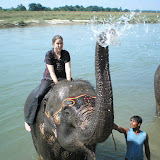
To top off the morning, we finished our walk at the riverside just in time for elephant bathing. By this time it was quite warm, and I was ready for a cool swim, so I decided to join the elephants (actually, this is one of the tourist attractions). With the help of the elephant trainer, I climbed up on one of the elephants, and he sprayed me with water from his trunk again and again. Then he decided to lay down in the river (in response to a command from the trainer – all part of the show), and dumped me off. How cool!

In the afternoon, I took an elephant safari. In other words, we rode elephants through the forest looking for game. They loaded us up four to an elephant, riding on a saddle with a wood frame. The motion took a little getting used to – rocking from side to side as the elephant lumbered along. They often went right through or over trees, so we had to watch out for overhanging branches. It was a lot of fun, and we spotted two rhinos, lots of deer (two types), monkeys, and wild boar. Not bad for a day’s safari!

Today, before departing from Chitwan, I went to the government elephant breeding center. This is where the female elephants come and wait for some handsome wild male elephant to sweep them off their feet. Seriously, though, they keep the mating far away from the village because the wild males can be very aggressive during mating season. The females carry the babies for two years before giving birth. There were several young-uns in the center, of varying ages. The most famous are the twin males – Ram and Laxman – about a year old. It is rare for elephants to have multiple births where both twins survive. Ram and Laxman are very curious and roam about the center freely, greeting visitors with their trunks searching for cookies. Unfortunately, the shop that sells elephant cookies (still don’t know exactly what they feed them) was closed for the holiday today, so the babies quickly deserted us when we didn’t have anything to offer them.

Friday, October 16, 2009

Community Health 2 and 3: School Clinic and Post-Partum Home Visits

Community Health

Chapter 2: School Clinic
Every Wednesday, the Community Health Program team goes out to a rural school to do health education, screening and physical exams. My trip to Bedbedanga Secondary School in the village of Siddhashwar, was one of the highlights of my time in Nepal. The community is located about two-hours by jeep and half an hour’s walk from Tansen. We traveled in a hired jeep with one intern doctor, Anoud, six nurses, myself and two teachers from the community. What a gorgeous drive! The day was crystal clear and cool, and the Himalayas were visible on the horizon for most of the trip. The road wound along the hills and ridges and up and down green valleys with rice paddies and streams. Half of the road was paved, with winding, hairpin turns down the hills. The other half was gravel/mud/rutted and potholed. By the time we reached the end of the road, I was ready to walk. We crossed over a river on a shaky suspension bridge, then walked through rice paddies and uphill to the school. (Nepali schools are frequently located on hilltops.)

The Bedbedanga Secondary School goes from grade 4 through 10, with 390 students and 12 teachers. Students come from the surrounding villages, some of them walking an hour and a half each way (up some pretty steep hills, too). We were greeted with a formal welcome and introduction to the staff and a huge lunch/brunch of daal bhaat at a teacher’s house. Stuffed to the gills, we then set up clinic in one of the classrooms. The kids lined up by class to get a check-up with one of the doctors or nurses. So for the next several hours, I used my broken Nepali to ask about cough, fever, stomach ache, headache, looked at eyes, ears and throat, checked heart and lungs. Whenever I had a positive response to my simple questions, I got Anoud (the intern) to help explore further – when does you stomach hurt? How long? What makes it hurt more?...
After all the students were seen, several of the teachers and a few community members came with an assortment of problems. Many wanted their blood pressure checked. Others complained of vision problems. It was quite an interesting day. We referred a handful of children to the hospital for further assessment, but most of the kids were pretty healthy. Everyone received a dose of anti-worm medicine.

The drive home was equally beautiful, and I arrived back in Tansen weary but with good memories.

Chapter 3: Post-Partum Home Visits

One day this week, I accompanied a community health nurse and community volunteers to visit several mothers who had recently delivered babies. This was a unique opportunity to see inside the typical Nepali home. I enjoyed the walk and the glimpse of Nepali family life.

The first house we visited belonged to poorer mother. Built on a steep hillside, the climb down was a bit scary. But the view from the patio was amazing. The family, including the toddlers, go up and down the steep hill every day, and they plant rice and vegetables on the terraced hillside. The mother was young but already had one other child, about a year and a half old. She lived with her in-laws, as it is customary in Nepali culture for the woman to move in with her husband’s family after marriage. Judging from the number of children and adults in the house, I would guess there were several sons with their wives and families living under one roof, sharing about three rooms. The mother-in-law was right at the center of activity, proudly showing off her new grandchild.

The nurse and community volunteer examined the mother and baby thoroughly, checking for any signs of infection, malnutrition, or poor sanitation. They asked about breastfeeding, the mother’s diet, and any post-partum complications. The community volunteer then counseled the mother on hygiene, feeding, and signs and symptoms of mother or baby requiring medical attention.

The community volunteers are married women with children who live in the community and have time available and interest in becoming health promotors. They receive training and supervision over a three year period and visit women in the community to give advice about pregnancy, child birth, and post-partum care. One of their tasks is to encourage women to go to the clinic for prenatal care and to have their babies in the hospital. Currently, according to the community health director, 50% of “urban” women and 80% of rural women deliver at home. Maternal mortality is still a leading cause of death for women in Nepal, and the mission hospital sees dozens of cases of obstructed labor, post-partum hemorrhage and maternal and newborn infections from home deliveries each month. That is why it is so important to have volunteers in the community who keep track of the pregnancies and deliveries and check up on women who have given birth to make sure all is well.

One mother we saw on the home visits was having problems with breastfeeding and pain after her cesarean section. The pregnancy had been complicated by typhoid and malaria, and the baby was born small (2.5 kgs) and had trouble latching on to nurse. The mother was anxious and frustrated, not to mention uncomfortable with milk building up and not getting released. Her surgery incision was infected, contributing to her pain. The visiting health team gave her some advice regarding feeding her baby and referred her to the hospital for treatment of the wound infection. When she heard she needed to go to the doctor, she began to cry because there was no one available to help her. Her husband was working in India and had been away for several months, and she had no other family nearby. The community volunteer offered to accompany her to the hospital. Poor mom! She had so many physical problems and was alone at such an emotionally challenging time. But that is why the post-partum visits are so wonderful. I imagine many new mothers have been encouraged and cheered by the company and advice of these friendly health workers. And many potential newborn and post-partum problems have been prevented.

Thursday, October 15, 2009

Community Health

Due to my interest and background in public health, I was eager to learn about the Tansen Hospital community health program. During the last two weeks of my time here in Tansen, I have been able to spend several days observing community health activities.

Chapter One: Town Clinic
The Town Clinic is a primary health care center operated jointly by Tansen Mission Hospital Community Health Program and the Nepali Ministry of Health. The clinic is housed in the District Hospital, an old, sturdy-looking building on the far side of the bazaar, in a section of town I had not seen previously. Staffed by nurses, the Town Clinic provides maternal and child health services to families who live in Tansen proper, including well-baby check-ups, immunizations, prenatal care, and family planning.

I was amazed at the number of women who showed up and paid money for preventive care and public health services. The waiting room was packed by 10 AM. I spent the morning seeing babies with Mana, the head nurse – very cute, healthy, happy babies. We did a complete physical exam, and Mana counseled each mother on proper nutrition, hygiene, and immunizations. In the afternoon, I worked with the antenatal team – taking blood pressures, measuring women’s bellies (to check the baby’s size), listening to babies’ hearts with a fetoscope (old fashioned version of our modern day dopplers) and checking for edema or other problems. The nurses also counsel women about contraception and HIV/AIDS and see minor acute childhood illnesses, such as colds and diarrhea. Overall, it was a very pleasant day and quite educational.

Tuesday, October 13, 2009

Nepali Language Class

Today I finished my last Nepali language class. During my six weeks here in Tansen, I attempted to learn some of the language so I could talk with patients. The hospital has an excellent language teacher (guru), Keela. I had private lessons for an hour three times a week where we covered vocabulary, grammar and some medical phrases. However, I did not try to learn the Nepali script, which is very similar to Hindi.

I love learning new languages, and I think I picked up the basics of Nepali pretty quickly. But it is one thing to speak and do drills in class and quite another to converse in real life. The average Nepali speaks with a lot of slang and informal grammar, not to mention slurring everything together so it is difficult to make out the individual words. I can ask a few simple medical questions, but usually the response is un-interpretable, so I tend to rely on translators most of the time. When listening to Nepali doctors interview the patients or hearing a sermon, I can pick out words and phrases, sometimes even enough to get the gist of the conversation, but usually not much more than that. It is frustrating not to be able to communicate directly with people and say the things I want. It is also humbling – reminding me that I am completely dependent on God for everything.

Although my time in Nepal is almost up and I will likely forget all the Nepali I’ve learned once I get home, I have had fun in the process. I feel grateful and confident that I can still learn a new language should I choose to do some long-term missionary work in the future. Language is an amazing thing when you think about it. Communication is a gift that God has given human beings so that we can relate to one another. To think that we are born with our brains wired to learn language, and that some people can learn several different languages and keep them all straight – it is truly amazing. There are so many languages, dialects and accents, and God understands them all. Now they separate us from others, but one day we will rejoice around the throne of heaven worshipping our king in a multitude of tongues yet as one people.

Here are some of the things the Nepalis will say to God in that day:


  • Danyabad Yesu – Thank you, Jesus

  • Prasansa hos Prabu – Praise be to the Lord

  • Yesu nauko jai hos – Praise the name of Jesus

  • Eswarlai maheema hose – Glory be to God

  • Aru nauma chaina tyo mukti - There is salvation in no other name

  • Hameelai titauchan sarwa sada – he loves us forever

Well, that’s enough language lesson for today!

Sunday, October 11, 2009

Missionary Life and Fellowship


Since my social calendar has become quite full lately, I thought I would devote this posting to talking about some of the ways missionaries here share their lives and build relationships with Christians and non-Christians. Despite a busy work schedule, the missionary doctors seem to find ample time to interact socially. Here is a glimpse of “missionary life” from my recent calendar:

Tuesday: Dinner with Nepali interns and residents
Manisha, a lovely female intern, cooked some delicious Nepali treats for the medical students – chikauni (potato salad), chicken curry, and khir (rice pudding). We brought fruit salad and veggie salad, which were quite a hit with our Nepali friends. I enjoyed learning more about my Nepali colleagues – their families, culture, education and experiences in medicine. Several of them attended medical school in China, so they know what it is like to live in a foreign country where they don’t speak the language.

Wednesday: Dinner and a movie
I spent my afternoon off with a Norwegian surgeon who is here for a year. She is also single, and I was encouraged by her trust in God to care for her and sustain her as she traveled alone to Nepal for a whole year. We have a lot in common actually and have enjoyed hanging out together and encouraging one another as single gals seeking to serve the Lord in medical missions.

Thursday: Dinner at Nanglo’s
I joined Alice (New Zealand medical student) and her husband Ben at the one nice restaurant in Tansen (called Nanglo's), which serves a selection of Indian, Nepali and Chinese food. Although the price is three times as much as the hospital canteen, you can still eat a very nice meal for less than five dollars.
Friday: Out on the Town
Alice and Ben showed me their favorite place to eat in the bazaar – Mini-Nanglo’s, or also affectionately called the “MoMo Man.” Accompanying us were Hans (a Swedish surgeon) and his wife Anita, and Morag, a Scottish teacher who is teaching English in a local school for a few months. The MoMo Man is a hole in the wall, literally. We sat at a table in the back room, which also serves as a bedroom and wash-room when the diners vacate the premises (the restaurant is also the owners’ home). Occasionally family members came to brush their teeth at the faucet 10 feet from our table.

Saturday: Nepali Church, Bazaar and Lunch, Bideshi Church and Movie Night
I started the day at Nepali church, where I now recognize many familiar faces – Kasi Ram (the tailor) and his family, several members of the hospital pastoral care team and the occupational thearapist, and many of the missionaries and their families. Following the service, I did some shopping and had lunch in the bazaar with Carrie – an Irish gal who used to teach the missionaries’ children – and Yvonne, who is the current missionary school teacher. I arrived back at the hospital guest house just in time for the “bideshi” (English-speaking) church service. Every two weeks, the missionary families gather for worship, prayer and reflection. They take turns leading the service. This week, an Australian family organized things, and it was neat to see the whole family participating. Church was followed by a fellowship meal and then a movie (for anyone interested, the movie was called Caravan – a documentary about the life of a village/tribe who carry their salt on yak-back through the mountains to trade – filmed in Nepal).

Sunday – Dinner with Dr. Lisa and family
I invited myself to Lisa’s house for dinner. Lisa is an American pediatrician who is responsible for supervising the medical student rotations. I really enjoyed working with her on pediatrics and wanted to spend some time hearing about her experiences as a long-term medical missionary. She answered all my questions about preparing for the field, raising support, keeping up with friends and family back home, etc. I hope I was able to encourage her as well.

Often the missionary families organize social activities for the Nepali interns and residents. One night, we joined them for a talk on “How to find your Jiwan saathi” (how to find your lifelong friend or mate). The couple who organized the event talked about the Nepali/Asian approach to marriage (often arranged) and compared the Christian concept of marriage. Then they shared their own story and some of the principles and practices that have made their marriage strong. They asked the interns what they wanted in a husband/wife and what they thought about marriage. It was an interesting time to learn about Nepali ideas of marriage, male/female and husband/wife roles. What a great way to engage the Nepalis on a topic of extreme interest that allowed some exchange of ideas about values and beliefs. Other missionaries open their homes for Bible study, prayer meetings, game nights, and other activities that allow casual interaction and an opportunity for Nepalis to see what a Christian home and family life is like.

As you can see, I have been blessed with wonderful friendships and fellowship here in Tansen, leaving me with little time to be bored or lonely! I am grateful for this glimpse of missionary life.

Thursday, October 8, 2009

Pastoral Care

Tansen Mission Hospital (TMH), as its name indicates, is a hospital with a mission. The hospital logo states, “We Serve, Jesus Heals.” One of ways TMH serves is through the Pastoral Care Team, a group of dedicated Christians who provide prayer, counseling, and financial assistance to patients and families. I had the privilege of spending two days with the pastoral care team, possibly the best two days I have had here in Tansen.

The team starts their day with worship and prayer in the hospital chapel. Then they make rounds on the wards. I joined Silas as he visited patients who were due to have surgery that day. Silas asks patients how they are feeling, tells them that the doctors in the hospital serve Jesus and believe that ultimately he is the one who heals the patients, and explains that we pray in Jesus’ name, knowing that God hears our prayers and will grant us the peace and joy that only he can give. He then asks the patient if they will let him pray for them, that their operation would go well and that they will have peace in their hearts. Most patients accept prayer, with varying attitudes - some grateful, others skeptical.
We visited one little girl, about 10 years old, who had fallen from the roof of her house and needed surgery to set her broken arm. Her father was with her, an older man of very humble background by appearances. He told us that this was the youngest of his ten children, and as he spoke, he got choked up and turned his face away to hide his tears. Silas was able to talk with him and pray for him. I think he was worried about his daughter, about the costs of the surgery and hospitalization and about his family back home. The prayer seemed to have a calming effect, and who knows what seeds were planted in this man’s heart regarding Jesus’ love for him and his family.
Next Silas counseled a young lady who had attempted suicide by swallowing agricultural pesticides. She explained that she had been angry with her father because he beat her when he was drunk. Silas talked with her about the perils of anger, shared some verses from the Bible and talked about God’s power to help us control our anger. Then he called her parents in and talked with them, explaining that their daughter’s suicide attempt was a cry for help – she longed for a close and loving relationship with her father. He pointed out that the father’s drinking was hurting the family and could have (almost had) tragic consequences. Silas encouraged the girl to tell her father how she felt about his drinking, and he admitted to having a problem with alcohol. Finally, Silas invited the family to the hospital prayer service (held at noon daily in the chapel), where he gave a message about how Jesus provides a better way of dealing with anger and stress than liquor or other vices. I don’t know if the message made any impact on the family, but they came and heard, and now at least the father knows there is someone who can help him stop drinking.

In the afternoon, I joined Seti, another pastoral care team member, as he interviewed patients to assess their financial need. The hospital has a charity fund to help patients who cannot afford to pay for the care they receive. The pastoral care team is responsible for deciding who is eligible for social services. They ask patients about the number of family/household members, employment and income, land holdings, number of oxen, goats and other animals, debt burden, and other possible sources of assistance (e.g., from relatives or community members). When patients are approved for charity funds, the pastoral care team explains to them that the funds come from Christians around the world who support the hospital and pray for the doctors and patients because they love Jesus. So everyone hears about the love of Christ before they leave the hospital.

During my time with Seti, we visited an elderly woman, 78 years old, who was admitted for heart failure and emphysema. She told us that her husband died 10 years ago, though in fact he had married a second wife 30 years earlier and had not provided well for her since that time. Her only son left her three or four years back and she has not heard from him since. Although she has land, it lies uncultivated because she has no one to help her farm it. She works as a day laborer when she can get work, carrying loads of firewood or other supplies for 50 Rupees a day - about 80 US cents. However, for the past month, she has been unable to work due to worsening heart failure and difficulty breathing. Currently, she lives with neighbors and depends on them for food. She does get a small “old age” pension from the government – 500 Rupees a month, about $US 80. As it turns out, she is a Christian and goes to church in her village. When we prayed with her, she literally wept with joy.

As I walked through the hospital wards with the pastoral care team, I saw the patients and families with new eyes. Sometimes on medical rounds, we focus on the physical problems – vital signs, wound infections, how the lungs sound – and don’t see the spiritual pain and sickness written in the faces of patients and their loved ones. These past few days, I have been more aware of the spiritual side. When I look around the wards, I see curiosity in the eyes of onlookers as they see us pray with patients. (Side Note: the hospital wards are very open with up to ten beds per room and little privacy. Everyone knows everyone else’s business. At times this is a good thing – parents in neighboring beds can look after each other’s children and encourage one another. But when doctors are visiting with one family, the entire room listens and watches, which is a little awkward.) Sometimes I see desperation and despair, weariness, depression, loneliness, pain, and longing. A kind word (even if I don’t speak Nepali), a gentle touch, even a smile can bring comfort to a patient who is alone and scared. I pray I never lose sight of the importance of this ministry and that I will never be afraid to enter into the spiritual side of my patients’ lives.

The Pastoral Care ministry at Tansen Hospital is special. Few hospitals in Nepal have a pastoral care department and even fewer have such a devoted Christian staff to carry out the vital task of bringing spiritual healing to the patients. It is a tremendous witness to patients, families and even the Nepali doctors and nurses.

Wednesday, October 7, 2009

Rain, Rain and more Rain

Today is the third day of rain in a row. I thought the monsoon season was over, but apparently it is having one last hurrah before the nice weather arrives. For the first time since arriving, I have needed my sweater – I only brought one – and wished I’d brought a rain coat. The water is desperately needed, as Nepal depends on hydroelectric power. In the dry season, the water shortage means hours a day without electricity, as well as limited water for household use. Unfortunately, the heavy rains have caused flash floods and landslides throughout Western Nepal, killing at least 36 people and injuring and displacing many others. Houses have been swept away or buried in mud and debris, and overflowing rivers have flooded crops and villages.

Today, we had a road vehicle accident arrive at the emergency room with nearly 60 injuries - most likely due to the slippery roads and poor visibility. Please pray for those affected!

In the morning doctors' meeting, we heard how the entire hospital staff worked together with great commitment and compassion to triage and care for all of the injured from the accident. Even the custodial and security staff helped by handing out blankets and comforting injured and scared children separated from their parents. This is truly a wonderful hospital to work for!

Tuesday, October 6, 2009

Reflections at Half-way Point

Actually, I am more than half-way through my clinical rotation here in Nepal, and many of you have asked me what I like most about Nepal, what I miss most about home, what challenges I've faced, and what I’m learning. So I thought it was time to take a few minutes to reflect on my experience thus far. I’ll start with the easiest question:

What do I like most about Nepal?
The people, the culture, the food, the natural beauty. Nepali people are extremely friendly, hospitable and gracious. The women dress in the most colorful saris and khurtas, so walking down the street is a feast for the eyes! Then, no matter where I walk, children run after me shouting “Namaste! How are you? What is your name? Where you from?” Nepali culture is rich in little niceties – greeting people on the street with a slight bow and hands clasped together, always asking about friends and family, offering tea to visitors. Nepalis also love to share their food, no matter how humble. In fact, I have been surprised several times when one of the Nepali interns invites me to try a bite of whatever he or she is eating at tea, right off their plate (if my brothers-in-law are reading this, take note!). I know we do these things too, but it seems more significant when you are a stranger in a foreign land to be the recipient of these small blessings.

Nepali food is amazing – a blend of Indian and Chinese really. I already described some of it in a previous entry. At about 10:00 each morning, after morning rounds, the interns and doctors head to the hospital canteen for chiyaa (tea). The chiya is made with milk, spices and sugar, much like what we call chai back home. For Nepalis, this is their breakfast, and they eat any of a number of tasty treats with tea:
  • samosas - fried, triangular shaped “hot pockets” filled with spicy potatoes and veggies
  • parartha - a cross between a tortilla and a pancake, sometimes filled with spicy potato
  • chole - something like a spicy chick pea stew
  • aalu achar - potatoes with tangy cucumbers
  • pakota - vegetable fritters
  • and momos - steamed dumplings filled with meat or veggies

And the scenery – well, Tansen is absolutely beautiful. The hospital complex is up on hill overlooking a valley planted with rice paddies – very green and lush this time of the year. In the morning, the valley is usually filled with mist or clouds. So I look out my window and see the green hills around a carpet of white - wow! Behind the green hills around Tansen, on a clear day, you can sometimes see the majestic, jagged, snow-capped peaks of the Himalayas. We are too far west to see Mount Everest, but some of the western peaks are nearly as tall. I’m told that any day now the weather will clear up and we will see the peaks every day. Can’t wait! I have enjoyed exploring the area on short and long walks. There are many trails and paths that lead to incredible vistas, forested hills and beautiful flowers.


What do I miss most from home? Not much really - Diet Coke, friends and family.

What are the biggest challenges?
Apart from the challenges I described in my previous post dealing with patients dying, I guess the biggest challenges are simply physical inconveniences – heat and humidity, travel and critters. Surprisingly, at 4000 feet above sea level, the weather has been much like Houston. The humidity plus strong sun light make for a rather uncomfortable stickiness most of the time. Fortunately, it does cool down at night, and I'm told that the cooler weather will arrive any day now.


Travel is always an adventure, as in any developing country. Buses only take off when they are over-full with people on the roof, in the aisle and hanging out the door. And they stop every two seconds to let someone on or off. The winding mountain roads are narrow with minimal shoulders, so passing other vehicles is frightening whether you are on the side looking straight down the steep cliff, or the side where your bus comes withing millimeters of the bus going hte other direction.

And then there are the bugs - little ones, big ones, biting ones, singing ones (cicadas). . . The ants are a constant, and not just in the kitchen - there is always a column of ants coming and going down my wall near the window. They clean up the dead bugs, crumbs, and other things I don’t even see, so I don't mind much, as long as they keep away from my bed. The spiders are my least favorites – big, long-legged, creepy looking spiders that come in the cracks of the windows or ceiling. I hate squishing them, but I just can’t bring myself to turn off the lights at night knowing there is a spider on the ceiling waiting to parachute down into my bed while I sleep. Oh, and last night, the guest house manager called me outside to see a snake he had killed right outside the guest house door (my room is right by the door). It looked like an innocent green grass snake to me, but I was told it was rather poisonous. Supposedly they don’t like to come inside – small consolation! I will definitely think twice before taking my laundry off the line at night, as the clothes lines are in a grassy area near the guest house.

What am I learning?
That is the most difficult question of all. I am not sure I can truly answer it now – it may take some time after I get back to Houston to discover the ways God has used my time and experiences here. I suppose I am learning about myself mainly. Am I willing and able to live and serve in a place like this? Could I ignore the inconveniences and discomforts for long-term? Would I be able to learn a new language and develop relationships with people from an entirely different culture? Would I be able to sustain my relationship with God? Would I find people to pray with and be accountable to?

The answer to all of these questions so far is YES. From past experience, though, I know that the first weeks in any new place are always fresh and exciting. It usually takes about six months for loneliness and homesickness to set in. So far, I haven’t really felt homesick or lonely, and I doubt I will get to that point before I leave. But even now I can see how God has provided encouragement, friendship, and even little tastes of home (movies, Skype video calls, even chocolate!). And I have “connected” with missionary doctors, Nepali interns, patients, and shopkeepers in the short time I have been here – perhaps not deeply, but enough to feel that I could build deeper relationships here if I had time. I do not know if I will come back to Nepal for short- or long-term work. I hope so. This time has certainly confirmed my desire to serve somewhere, somehow in a poor country like Nepal. I can see how God is using the missionary doctors here to further his kingdom, encourage the Nepali church, and share his love with people who are poor, sick and needy. And I know I want to be a part of something like this.

Sunday, October 4, 2009

My Patients and My Patience

As my Nepali improves, and my knowledge of the hospital routine, I have had some really good experiences taking care of patients. Kalpana is an 8-year-old girl who came in with meningitis/encephalitis – an infection of the brain that can be caused by bacteria or viruses (some of them mosquito-borne). When she arrived, she was unconscious and paralyzed on the right side. During her two weeks in the hospital, she made very slow but significant recovery. She woke up, responded to commands, was able to move her right arm and leg a bit, eat, and sit up (with assistance). However, she still isn’t talking and has not recovered full strength in her limbs yet, so her prognosis is guarded. The occupational and physical therapy team worked with her and her parents, showing them exercises to do with her to re-teach her brain to coordinate movement and hopefully strengthen her muscles. I enjoyed being a part of her care team and learned a lot about encephalitis and meningitis in the process. It was great to write her discharge and see her parents take her home. Please pray that she recovers fully. A child with physical handicaps is a tremendous burden on a rural Nepalese family.

Sisir is a 5-year-old boy who presented with a huge lump under his right jaw. It looked like mumps, but mumps is generally on both sides of the face. He had a low-grade fever and tenderness in the area. It could have been an enlarged lymph node or a developing abscess. The lump measured 7 x 5 cm on admission, but quickly shrunk to less than 2 x 2 with IV antibiotics. He was very happy to be able to go home for Dasai! Sisir’s dad spoke a little English, which made my daily interview and exam much easier. And I heard Sisir counting to ten in English on one occasion, so I entertained him by trying to count to ten in Nepali.

Bikram is a 3-year-old boy who came in with 15 days of fever, decreased appetite, and general malaise. He had a huge liver and spleen and was diagnosed with typhoid or enteric fever (caused by Salmonella typhi – not the same Salmonella that causes food poisoning, but related). His mother was beside herself because day after day, Bikram kept spiking really high fevers and not eating well. One day she was in tears with worry and asking why he wasn’t getting better. Typhoid is like that – it can go on for days or weeks, even with antibiotics. I told her in very bad Nepali that I was praying for her – no idea if she understood or not – and asked the pastoral care team to visit and pray with her (I don’t know how it was received or what effect it had). However, the next day, mom was all smiles and reported that Bikram was better, the fever was much less, and he was eating well. They went home the next day, very grateful for a good recovery. I hope that somehow they experienced the love and healing of God during their short stay here.

Other stories are not so happy. I have seen so many children die the past four weeks – of meningitis, overwhelming infection, and respiratory failure. This week, I was taking care of a preemie born at 31 weeks (about two months early) weighing 1700 grams (normal 3000-3500). He was jaundiced and had to be placed under a special lamp. And he had a heart murmur from a patent ductus arteriosus (a shunt between the aorta, which pumps blood to the body, and the pulmonary artery, that channels blood to the lungs to pick up oxygen). A PDA is normal and useful before birth, and it usually closes within hours to days after birth. But this baby’s stayed open for some reason, causing his little heart to work harder, pumping more blood through his lungs, and decreasing flow to the rest of his body. Then, unfortunately, he developed necrotizing enterocolitis (NEC) – a condition in which portions of the intestine become injured and die, causing bleeding in the stool and even perforation of the intestines at times. Premature babies are at higher risk of NEC and are less likely to recover. This poor little guy just couldn’t overcome all of the problems he faced. He started having trouble breathing and finally just stopped. It was really hard to see him in the end, but it was even harder to see his mother’s reaction. She was beside herself with grief from the moment he began to go downhill, sobbing, wailing and even falling (or throwing herself) on the floor in agony.

Perhaps even more troubling to me, though, is the lack of emotion from parents. One night in the emergency room, a 2-week old baby was brought in blue and not breathing. We tried to resuscitate him unsuccessfully, and he was pronounced dead on arrival. The parents did not show any sign of distress. They simply signed the paperwork and took the body home. Some people say that parents here don’t get “attached” to their babies too soon because death in infancy and early childhood is so common. In fact, many babies are not given a name until some days or weeks after birth. It is hard for me to believe this is truly the case. Surely any woman who has carried a child in her womb for nine months and nursed him at her breast for even a short time would feel some grief if the child died. Perhaps those parents who don’t appear to grieve are simply hiding their pain deep inside until they can express it in private. I suppose doctors do the same thing. I certainly felt like weeping and wailing for that baby – so cute and chubby like all babies are, but lifeless – and yet I simply went on with my work.

Seeing children die is a challenge to my spiritual and emotional equilibrium. I am forced to grapple with the reality of death and disease while attempting to show empathy, compassion and love to my patients and their families. How do I feel their pain without succumbing to it? It is such a joy to see a child get well, to see a baby smile and coo or a 5-year-old running down the hall of the pediatric ward. But to see a child in pain, gasping for breath or delirious with fever defies everything that is good and right and beautiful. I am so thankful that we have medicines and procedures that make people better, and that God in his mercy has given us bodies that have remarkable healing capacity and the knowledge and ability to harness that capacity to speed or assist the healing process. Ultimately, however, life is not ours to give or take, and even as a doctor I can only wait on God and plead for his mercy. It’s humbling. But I have been meditating on his promise that one day he will wipe away every tear, and there will be no more sickness, no more death, no more pain or grief. In the meantime, I find I need to go to him every day to renew my capacity to love and show compassion.

Saturday, October 3, 2009

Hindu Festival

Dasai is a major Hindu festival in Nepal, sort of like our Christmas. The festival lasts for 10 days and commemorates the mythical victory of Lord Rama over Ravana, the demon king of Sri Lanka. Dasai is a family holiday, so Nepalis travel home to gather with relatives for feasting and worshipping various gods with prayer, offerings and sacrifices (goats mainly). There are special blessings for family members, homes, vehicles, etc., and everyone gets new clothes. Children and younger family members receive special blessings from elders, which are bestowed with a tika (red spot) on the forehead. One source told me that on one of the days of Dasai, people worship dogs, so they put tikas and bangles on their dogs and treat them nicely for a day. On the two main days of the festival, people take their goats to the temple to sacrifice to one of the Hindu gods. They also build huge bamboo swing sets, and I heard there was a ferris wheel in the bazaar. (No wonder there were so many broken arms in the hospital over Dasai!)

I managed to have a good conversation with one of the pediatric interns before he left for the holiday. I asked him what Dasai meant to him, and he said it was pretty much just a cultural thing, a time to be with family and friends. He does not believe in any god and hasn’t since he was a small child. Although he will receive a tika from his parents and grandparents at Dasai, he does not plan to worship at the temple. I hope to have more conversations with others over the next few weeks, as it is a good way to start conversations about faith and beliefs.

Things at the hospital were really busy despite the holiday. Other area hospitals were closed, so the mission hospital here in Tansen received many referrals of critically ill/injured/pregnant patients. Half of the interns and residents were on holiday, so I actually felt useful helping on rounds and in the Emergency Room.